

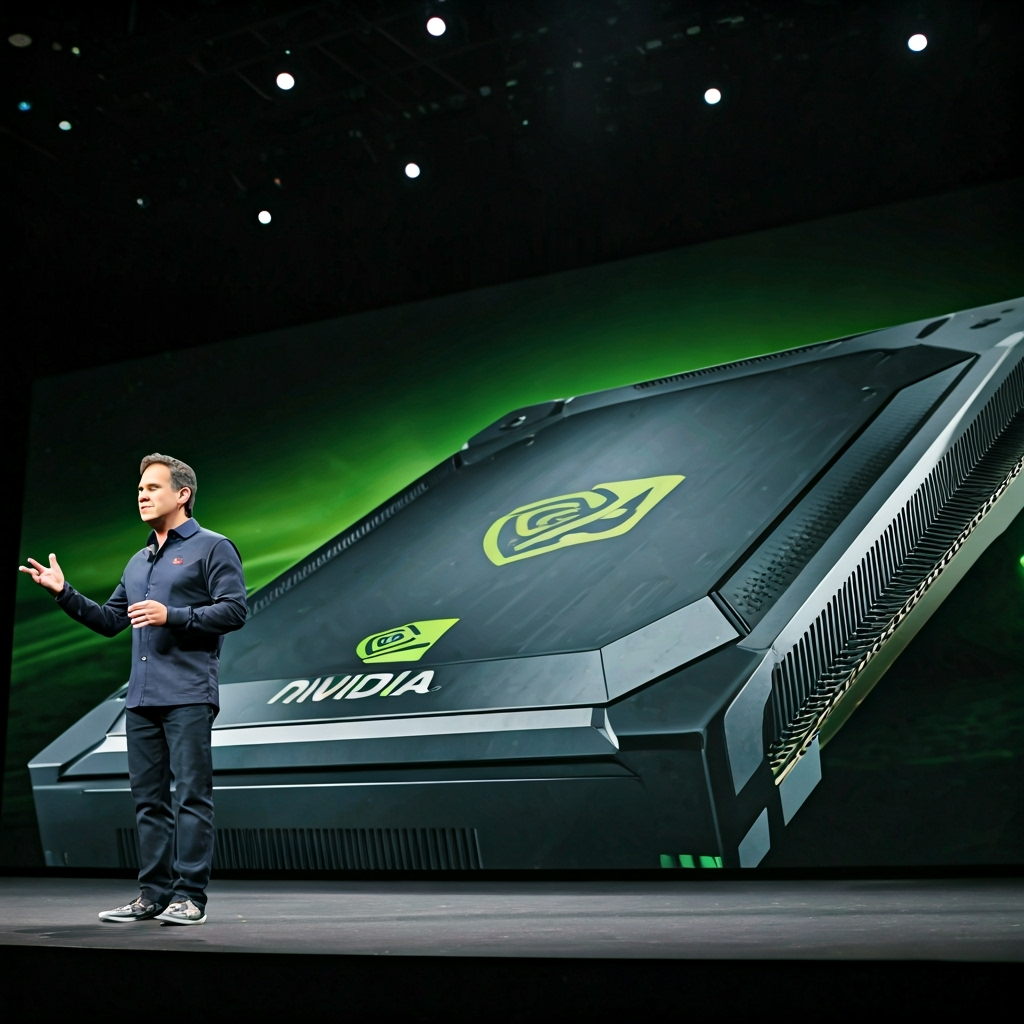
Santa Clara, CA – Nvidia today formally introduced its “Blackwell” series of AI GPUs, a successor to the highly successful “Hopper” architecture, during its annual GTC conference. CEO Jensen Huang highlighted the Blackwell GPUs’ capabilities, emphasizing their exponential performance gains for training and inference across the most complex AI models. The architecture, named after mathematician David Blackwell, features a massive 208 billion transistors and incorporates a second-generation Transformer Engine, enhancing the efficiency of large language model operations.
The flagship chip, the GB200 Grace Blackwell Superchip, integrates two Blackwell GPUs with Nvidia’s Grace CPU, forming a powerful system-on-chip designed for extreme scale AI workloads. Nvidia claims a 30x performance increase for large language model inference and a 4x improvement in training speeds compared to its H100 predecessors, while significantly reducing power consumption. This efficiency is critical as the energy footprint of AI data centers becomes a growing concern.
The announcement comes at a time when competition in the AI chip space is intensifying, with companies like AMD, Intel, and numerous startups vying for a share of the lucrative market. However, Nvidia’s established software ecosystem, CUDA, remains a formidable moat, making it challenging for rivals to displace the company from its dominant position. Major cloud providers and AI research labs are expected to be early adopters of the Blackwell architecture, given the ever-increasing computational demands of state-of-the-art AI. The move underscores Nvidia’s strategic vision to continually push the boundaries of AI hardware, ensuring its products remain at the forefront of technological innovation.


 English
  Deutsch