

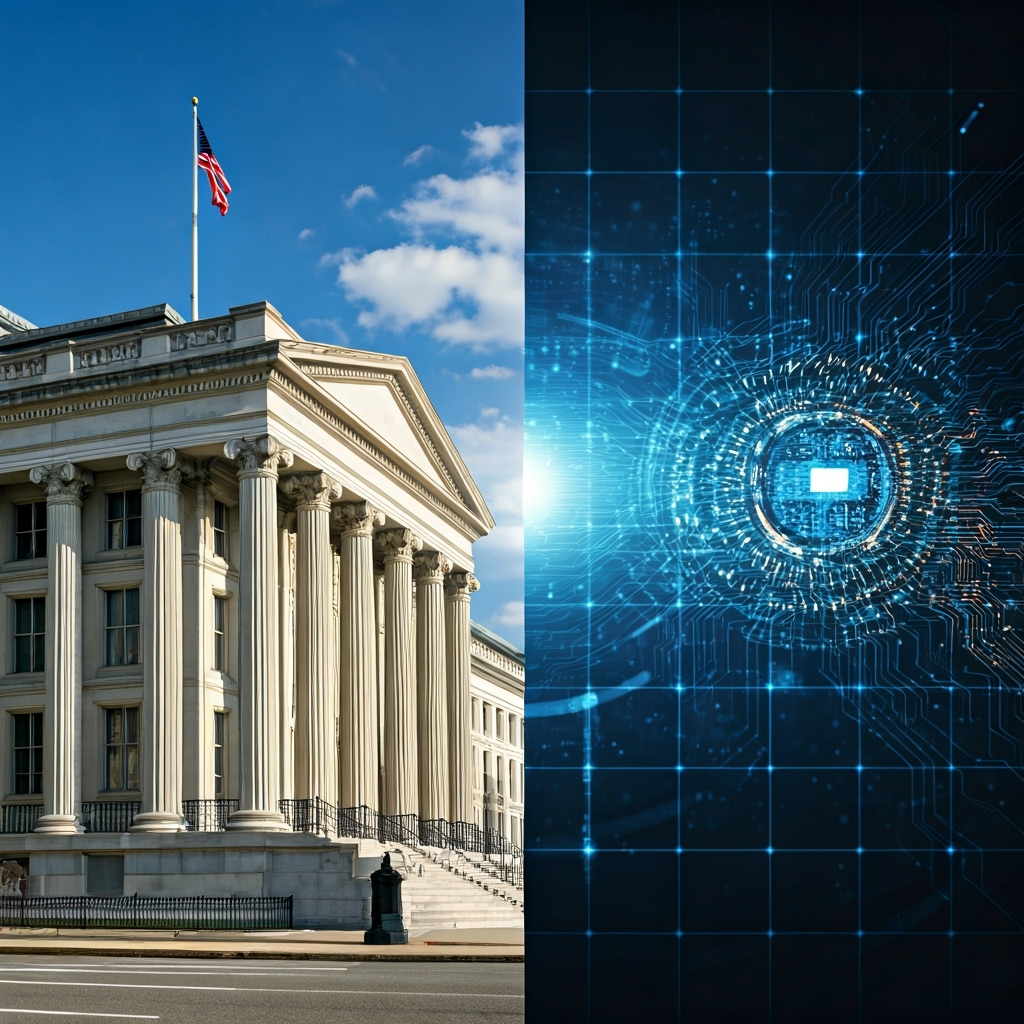
The U.S. Department of the Treasury has taken a significant step in the nation’s ongoing technology competition with China, releasing a Notice of Proposed Rulemaking (NPRM) aimed at restricting American investments in key Chinese high-tech sectors. The proposed rule, which implements an executive order signed by President Biden, seeks to prevent U.S. capital and expertise from fueling the development of technologies that could threaten American national security.
The regulation specifically targets U.S. investments in Chinese companies involved in three sensitive fields: advanced semiconductors and microelectronics, quantum information technologies, and artificial intelligence. The Treasury Department’s proposal outlines a “narrow and targeted” approach, distinguishing it from broader economic decoupling. It aims to prohibit certain transactions while requiring notification for others, creating a precise framework to address security risks.
Under the proposed rule, the focus for AI is particularly on systems designed for military, intelligence, surveillance, or cyber-enabled operations. The regulation would not only restrict direct financial investments, like private equity or venture capital, but also other arrangements that could transfer knowledge and expertise. This is a critical aspect of the strategy, as the government argues that U.S. investment lends intangible benefits, including corporate governance expertise and valuable industry connections, to the targeted companies.
The move marks a new front in Washington’s strategy to slow Beijing’s technological ascent, expanding from export controls on hardware to regulating the flow of American capital. The Treasury is now soliciting public feedback on the draft rule, which is expected to draw intense debate from both national security advocates and the investment community. Venture capital firms and financial institutions will be closely watching how the final rule is shaped, as it could significantly alter the landscape for U.S. investment in the world’s second-largest economy. The outcome will set a new precedent for how the U.S. government uses financial policy to address geopolitical and security challenges.


 English
  Deutsch